
1. WHO IS REALLY THINKING?
We constantly describe experience through the language of self.
"I see."
"I think."
"I remember."
"I am angry."
These expressions are useful in everyday communication. But the Buddha's teaching invites us to investigate whether consciousness is truly a permanent self or an independent observer.
In our series on the Four Ultimate Realities (Paramattha Dhamma), we introduced:
- Citta: Consciousness
- Cetasika: Mental factors
- Rūpa: Material phenomena
- Nibbāna: The Unconditioned
After exploring the 52 Cetasikas and 28 Rūpa, we now examine Citta, the first ultimate reality in the traditional Theravāda Abhidhamma classification.
2. WHAT IS CITTA?
Citta is commonly translated as consciousness.
Its essential function is knowing an object.
An object can be a visible form, sound, smell, taste, tangible quality, or mental object.
Consciousness does not arise as an independent permanent entity. It depends on conditions.
For example, seeing-consciousness requires the relevant conditions involving the eye and visible form.
The Buddha explains this conditional relationship in MN 148, the Chachakka Sutta.
According to traditional Abhidhamma, consciousness is momentary. Each citta arises and ceases with accompanying mental factors.
Citta is therefore not an eternal soul, a permanent inner witness, or an independent controller.
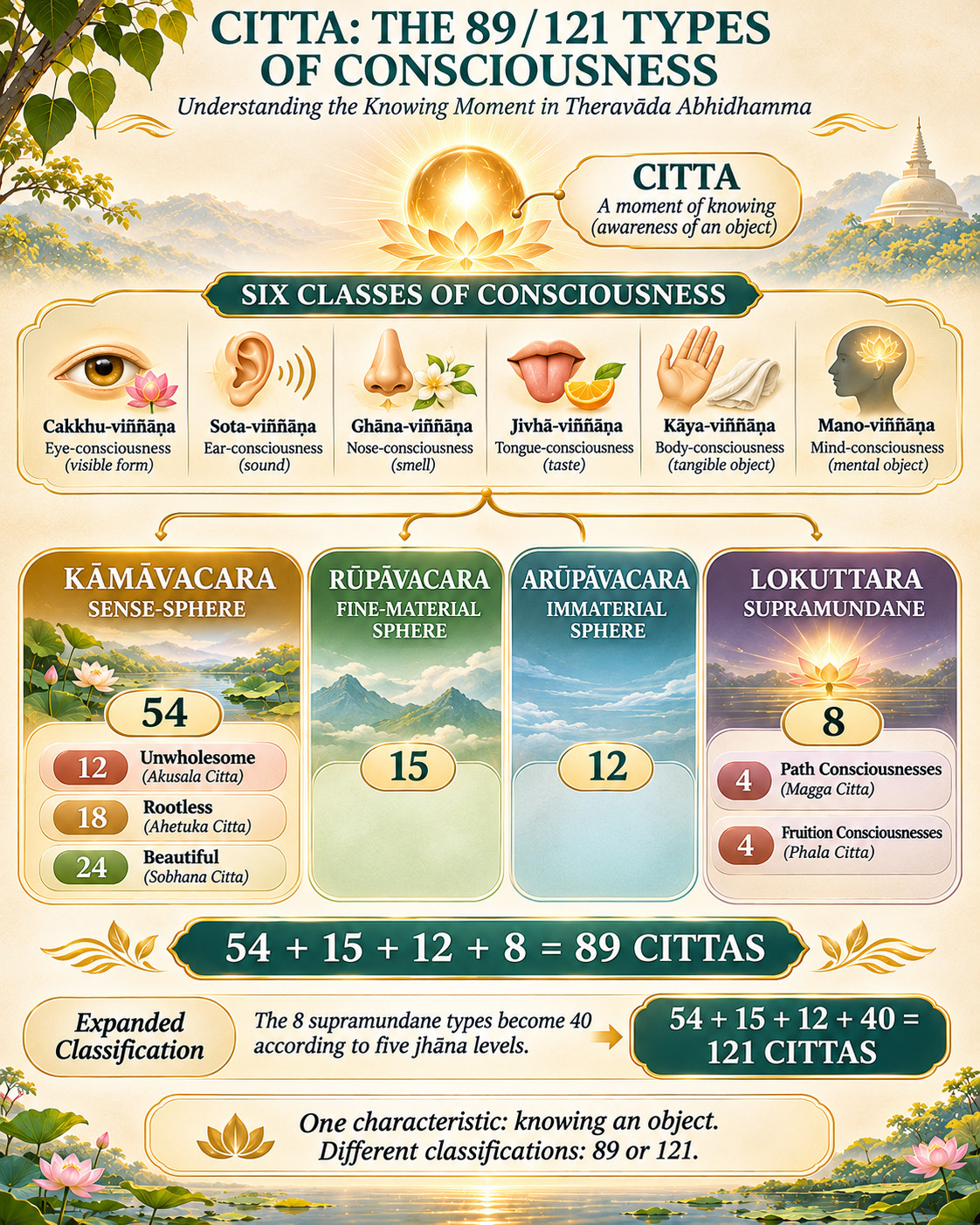
3. THE SIX CLASSES OF CONSCIOUSNESS
The discourses describe six classes of consciousness.
- Cakkhu-viññāṇa: Eye-consciousness, which knows visible form.
- Sota-viññāṇa: Ear-consciousness, which knows sound.
- Ghāna-viññāṇa: Nose-consciousness, which knows smell.
- Jivhā-viññāṇa: Tongue-consciousness, which knows taste.
- Kāya-viññāṇa: Body-consciousness, which knows tangible objects.
- Mano-viññāṇa: Mind-consciousness, which knows mental objects.
These explain the six sense-based ways consciousness occurs.
For example, hearing a person's words is not the same as mentally interpreting their meaning. Several conditioned processes are involved in what appears to be one continuous experience.
This distinction is important when investigating how perception, feeling, craving, and clinging develop.
4. WHY DOES ABHIDHAMMA DESCRIBE 89 OR 121 CITTAS?
Although consciousness always performs the basic function of knowing an object, different types arise with different characteristics, functions, and accompanying mental factors.
The Abhidhammattha-saṅgaha classifies consciousness into 89 types.
A. Sense-sphere consciousness: 54
These are called Kāmāvacara Cittas.
They include consciousness connected with ordinary sense experience and related mental processes.
They are subdivided into:
• 12 Unwholesome cittas
• 18 Rootless cittas
• 24 Beautiful sense-sphere cittas
Total: 54.
B. Fine-material-sphere consciousness: 15
These are called Rūpāvacara Cittas.
They are associated with fine-material jhāna attainments and related resultant or functional states.
Total: 15.
C. Immaterial-sphere consciousness: 12
These are called Arūpāvacara Cittas.
They relate to the four immaterial attainments and their corresponding types of consciousness.
Total: 12.
D. Supramundane consciousness: 8
These are called Lokuttara Cittas.
They include:
• Four path consciousnesses
• Four fruition consciousnesses
These correspond to the four stages of awakening:
- Stream-entry (Sotāpatti)
- Once-returning (Sakadāgāmi)
- Non-returning (Anāgāmi)
- Arahantship (Arahatta)
Total: 8.
Thus:
54 + 15 + 12 + 8 = 89 cittas.
In the expanded system, the eight supramundane types become forty when classified according to five jhāna levels.
54 + 15 + 12 + 40 = 121 cittas.
This does not mean consciousness has 121 permanent parts.
These are traditional classifications of moments of consciousness.
5. ANOTHER CLASSIFICATION: THE FOUR ETHICAL TYPES
The same 89 cittas can also be classified according to their ethical and functional nature.
• Akusala: 12 unwholesome cittas.
• Kusala: 21 wholesome cittas.
• Vipāka: 36 resultant cittas.
• Kiriya: 20 functional cittas.
Total: 89.
This explains an important point.
Not every moment of consciousness creates new kamma.
Some states are wholesome or unwholesome, others are results of past kamma, and others perform functions without producing new kamma.
Volition, an accompanying mental factor, is particularly important in understanding intentional actions.
6. HOW DO CITTA AND CETASIKA WORK TOGETHER?
Citta never arises alone.
According to the traditional Abhidhamma analysis, every moment of consciousness is accompanied by mental factors.
Citta knows an object.
Cetasikas perform associated functions such as contact, feeling, perception, intention, and attention.
For example, when someone criticizes you, hearing-consciousness knows sound. Other moments of consciousness and associated mental factors participate in recognizing its meaning and forming a response.
Anger may arise, or mindfulness and wisdom may support restraint.
The process is conditioned rather than controlled by an unchanging inner self.
7. WHY IS THIS IMPORTANT IN DAILY LIFE?
Consider three experiences.
Anger
Someone sends you an unpleasant message.
The mind repeatedly recalls it and develops hostile thoughts.
Understanding consciousness helps you distinguish the initial experience from the continued mental activity that increases suffering.
Anxiety
A possible future event becomes the object of thought.
The mind returns to imagined outcomes repeatedly.
Recognizing thinking as a changing process can help reduce automatic identification with frightening predictions.
Pleasure
A pleasant experience occurs.
The mind wants it to continue.
Understanding impermanence helps prevent the expectation that a changing experience can provide permanent satisfaction.
The aim is not to suppress consciousness or deny emotions.
It is to understand how experience arises and how mental reactions can be cultivated wisely.
8. A SIMPLE MINDFULNESS PRACTICE
Begin with ordinary activities.
When seeing, recognize seeing.
When hearing, recognize hearing.
When thinking, recognize thinking.
When a strong emotion arises, notice the mental state and the sensations accompanying it.
Do not imagine a permanent observer separate from these events.
Instead, investigate how experiences arise, change, and cease.
Notice whether pleasant feeling is followed by craving, or unpleasant feeling by aversion.
These reactions are not inevitable. Mindfulness and wisdom can change how we relate to experience.
This practice is consistent with the broader principles of Satipaṭṭhāna and the investigation of the six sense bases.
9. HOW DOES UNDERSTANDING CITTA SUPPORT ENLIGHTENMENT?
The Buddha taught that consciousness is one of the five aggregates.
In SN 22.59, the Anattalakkhaṇa Sutta, consciousness is described as impermanent and not-self.
The practitioner investigates:
Anicca: Consciousness changes.
Dukkha: It cannot be relied upon as a permanent source of satisfaction.
Anattā: It is not an independent, enduring self.
When understood through insight, these characteristics help weaken identification with consciousness.
This is an essential aspect of the development of wisdom.
But memorizing the 89 or 121 classifications does not itself produce enlightenment.
Liberating insight develops through the Noble Eightfold Path, including ethical conduct, mindfulness, concentration, and wisdom.
10. SCRIPTURAL REFERENCES
The Abhidhamma Piṭaka is part of the Theravāda Pāli Canon.
The 89 and 121 classifications are systematically presented in the later Abhidhammattha-saṅgaha, Chapter I.
Relevant discourses include:
• MN 148: Chachakka Sutta, six sense bases and consciousness.
• SN 22.59: Anattalakkhaṇa Sutta, consciousness as not-self.
• MN 10: Satipaṭṭhāna Sutta, mindfulness of experience.
• SN 12.2: Paṭiccasamuppāda-vibhaṅga Sutta, dependent origination.
These sources provide complementary perspectives on consciousness.
FINAL REFLECTION
What we call "my mind" is not a single unchanging observer.
It is a succession of conditioned experiences, with consciousness arising together with mental factors.
Understanding Citta can help us become less reactive, less attached to mental states, and more aware of how suffering develops.
The greatest opportunity is not merely to classify consciousness.
It is to understand experience so clearly that clinging begins to lose its hold.
That is how studying Citta can support the path toward liberation.
Comments
No comments yet. Be the first to comment.