
Is your body really the permanent, independent thing you call "me"?
We identify with appearance, health, strength and possessions. Yet all of them change. Theravāda Buddhism offers a way to investigate physical experience rather than merely react to it.
In our earlier discussion of the four ultimate realities (paramattha dhammas), we introduced citta (consciousness), cetasika (mental factors), rūpa (material phenomena) and Nibbāna (the unconditioned). The first three are conditioned. This article examines rūpa through the traditional classification of 28 material phenomena.
1. CONVENTIONAL AND ULTIMATE TRUTH
In everyday speech, we say "person", "body", "cup" and "tree". These are meaningful conventional designations (sammuti or paññatti).
Abhidhamma also analyzes experience through fundamental categories called ultimate realities (paramattha dhammas). A "person" is a useful designation for changing mental and material processes, not an independently existing permanent self.
This distinction does not mean that people or objects are imaginary. It helps us avoid mistaking a useful concept for something unchanging.
2. THE 28 TYPES OF RŪPA
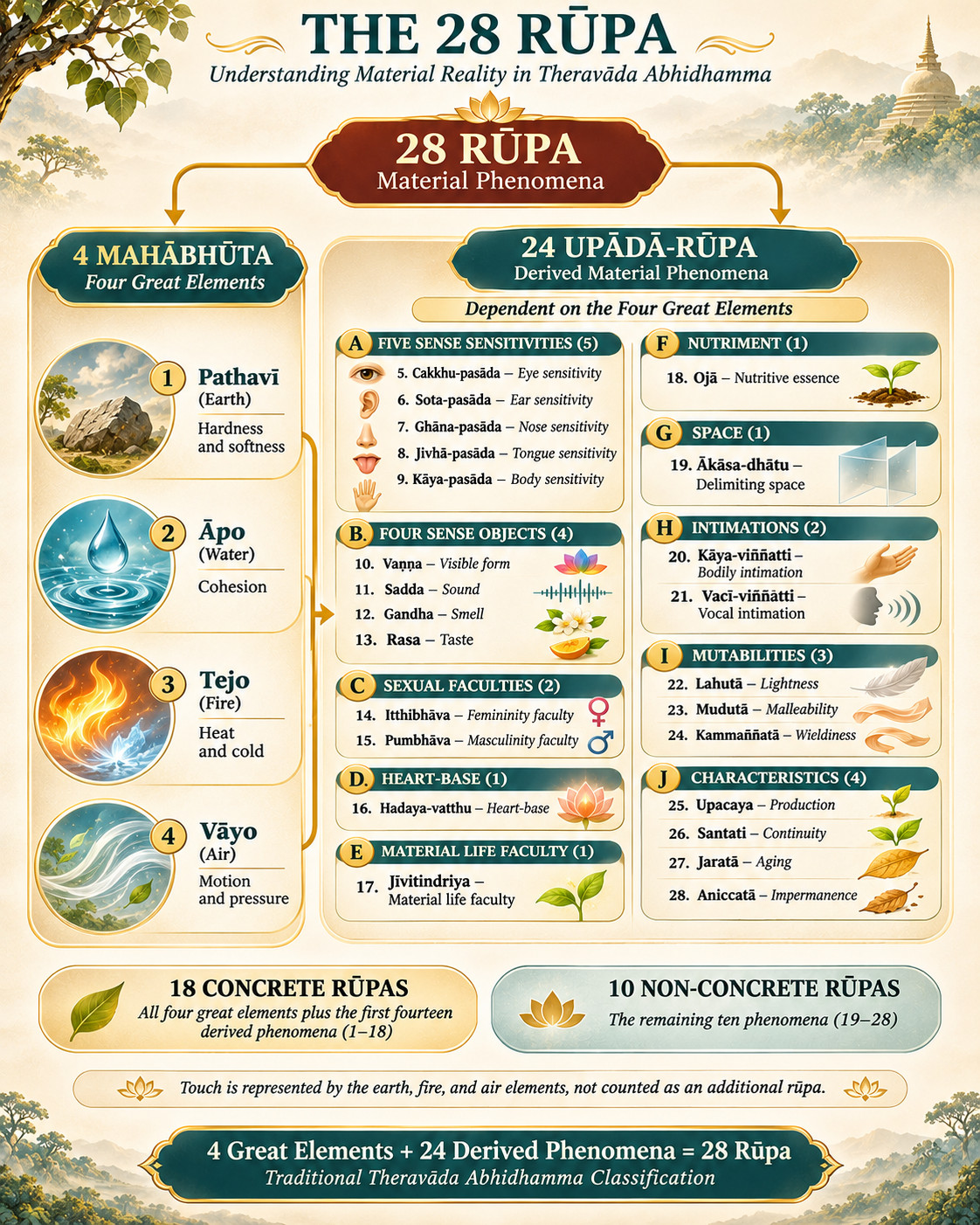
Rūpa means material phenomena. In the classical Theravāda Abhidhamma system, 28 rūpas fall into four great elements (mahābhūta) and 24 derived phenomena (upādā-rūpa). They are not 28 chemical elements or microscopic particles. They describe material characteristics, functions and processes.
THE FOUR GREAT ELEMENTS (4)
- Pathavī-dhātu, earth: hardness and softness.
- Āpo-dhātu, water: cohesion or binding.
- Tejo-dhātu, fire: temperature, heat and cold, and maturation.
- Vāyo-dhātu, air: motion, pressure and distension.
These are not simply soil, drinking water, flames and wind. Their names refer to fundamental characteristics within this Buddhist analysis.
THE 24 DERIVED MATERIAL PHENOMENA
Five sense sensitivities (5)
- Cakkhu-pasāda: eye sensitivity.
- Sota-pasāda: ear sensitivity.
- Ghāna-pasāda: nose sensitivity.
- Jivhā-pasāda: tongue sensitivity.
- Kāya-pasāda: body sensitivity.
These support the corresponding sense-consciousness processes. They are not identical to entire anatomical organs.
Four sense objects (4)
- Vaṇṇa: visible form or color.
- Sadda: sound.
- Gandha: smell.
- Rasa: taste.
Why no separate touch object? Tangible qualities are already counted as the earth, fire and air elements. Cohesion is not directly apprehended through bodily touch in this classification.
Sexual faculties (2)
- Itthibhāva: femininity faculty.
- Pumbhāva: masculinity faculty.
These are classical material categories, not a comprehensive modern account of biological sex or gender.
Heart-base (1)
- Hadaya-vatthu: heart-base, described in later Theravāda analysis as material support for certain consciousnesses. This is not an established neuroscientific claim about the anatomical heart.
Material life faculty (1)
- Jīvitindriya-rūpa: life faculty sustaining associated kamma-produced material phenomena.
Nutriment (1)
- Ojā: nutritive essence that supports material phenomena.
Space (1)
- Ākāsa-dhātu: space delimiting material groups, not outer space.
Intimations (2)
- Kāya-viññatti: bodily intimation, such as an intentional gesture.
- Vacī-viññatti: vocal intimation, the material expression involved in speech.
Mutabilities (3)
- Lahutā: lightness.
- Mudutā: malleability or pliancy.
- Kammaññatā: wieldiness or adaptability.
Characteristics (4)
- Upacaya: production or initial arising.
- Santati: continuity.
- Jaratā: aging or decay.
- Aniccatā: impermanence or dissolution.
Another way to group the same 28:
- 18 concrete rūpas (nipphanna-rūpa): the four great elements and items 5 through 18.
- 10 non-concrete rūpas (anipphanna-rūpa): items 19 through 28, describing delimitation, expression, modification and characteristics rather than separately produced material substances.
Thus 4 + 24 = 28, and also 18 + 10 = 28. These are two ways of grouping the same phenomena, not additional types.
3. HOW DOES MATTER ARISE?
Classical Theravāda Abhidhamma describes four principal origins of produced materiality:
- Kamma: certain material phenomena connected with past intentional actions.
- Citta: certain material phenomena arising in dependence on consciousness.
- Utu: temperature or the fire element.
- Āhāra: nutriment.
Not every rūpa has all four origins. The non-concrete categories describe aspects of material processes and are not independently produced substances. This framework highlights conditionality, not the existence of a permanent bodily essence.
4. HOW DOES THIS RELATE TO EVERYDAY EXPERIENCE?
Imagine holding a warm cup of tea. In conventional language, "I am holding a cup." On closer examination, there is color, warmth, hardness or pressure; sense sensitivity; consciousness knowing a sensory object; and accompanying mental factors that interpret the experience.
The cup and hand are useful conventional labels. The experience can also be examined as changing mental and material processes. The teaching does not ask us to deny ordinary life, only to see it without inventing a permanent owner.
This matters when we face aging, illness or loss. Physical change may be unavoidable, but the thoughts "I must never change" and "this must always be mine" can add avoidable distress. Understanding impermanence encourages responsible care without excessive clinging.
5. A SIMPLE PRACTICE
Sit comfortably and attend to bodily experience. Notice hardness or softness where you touch the chair. Notice warmth or coolness, pressure, movement or distension. Observe their changing nature.
Then notice the mental response. Does an unpleasant sensation lead to irritation? Does a pleasant one lead to wanting more? Recognize sensations, feelings and thoughts without treating any of them as a permanent self. Adjust your posture or seek medical attention when needed; contemplation is not bodily neglect.
This is inspired by the contemplation of elements in Satipaṭṭhāna. You do not need to identify all 28 rūpas directly during meditation. The classification is a study aid, while insight develops through careful observation and practice.
6. HOW DOES THIS SUPPORT ENLIGHTENMENT?
In SN 22.59, the Anattalakkhaṇa Sutta, the Buddha explains that material form is not-self: it changes, is vulnerable to affliction and cannot simply be commanded to remain as we wish.
Seeing rūpa with wisdom develops insight into:
- Anicca: impermanence.
- Dukkha: inability to provide lasting satisfaction or security.
- Anattā: not-self.
The goal is not to memorize 28 names. It is to weaken clinging and cultivate wisdom within the Noble Eightfold Path, supported by ethical conduct, mindfulness and concentration.
7. WHERE DOES THIS CLASSIFICATION COME FROM?
The Abhidhamma Piṭaka is part of the Theravāda Pāli Canon and analyzes mental and material phenomena. The familiar systematic presentation of exactly 28 rūpas is especially clear in later Theravāda manuals, notably the Abhidhammattha-saṅgaha, Chapter VI. It is important not to present every detail of that later organization as a verbatim statement from an early discourse.
For further study: Dhammasaṅgaṇī; Abhidhammattha-saṅgaha, Chapter VI; MN 10 (Satipaṭṭhāna); MN 28 (Mahāhatthipadopama); MN 62 (Mahārāhulovāda); and SN 22.59 (Anattalakkhaṇa).
FINAL REFLECTION
The body deserves care, but it is not a permanent refuge. The 28 rūpas offer a detailed traditional framework for understanding conditioned materiality. When that understanding is joined with direct observation, we can respond to change more wisely, weaken identification with "I" and "mine", and progress toward liberation.


Comments
No comments yet. Be the first to comment.