
How the Buddha's similes, Theravāda Abhidhamma, and modern science illuminate change
Is the mind one continuous observer, or does what we call "my mind" consist of changing experiences?
A sound is heard. A memory appears. An emotion rises and fades. We experience a seemingly continuous life, yet the Buddha invited us to investigate its changing nature.
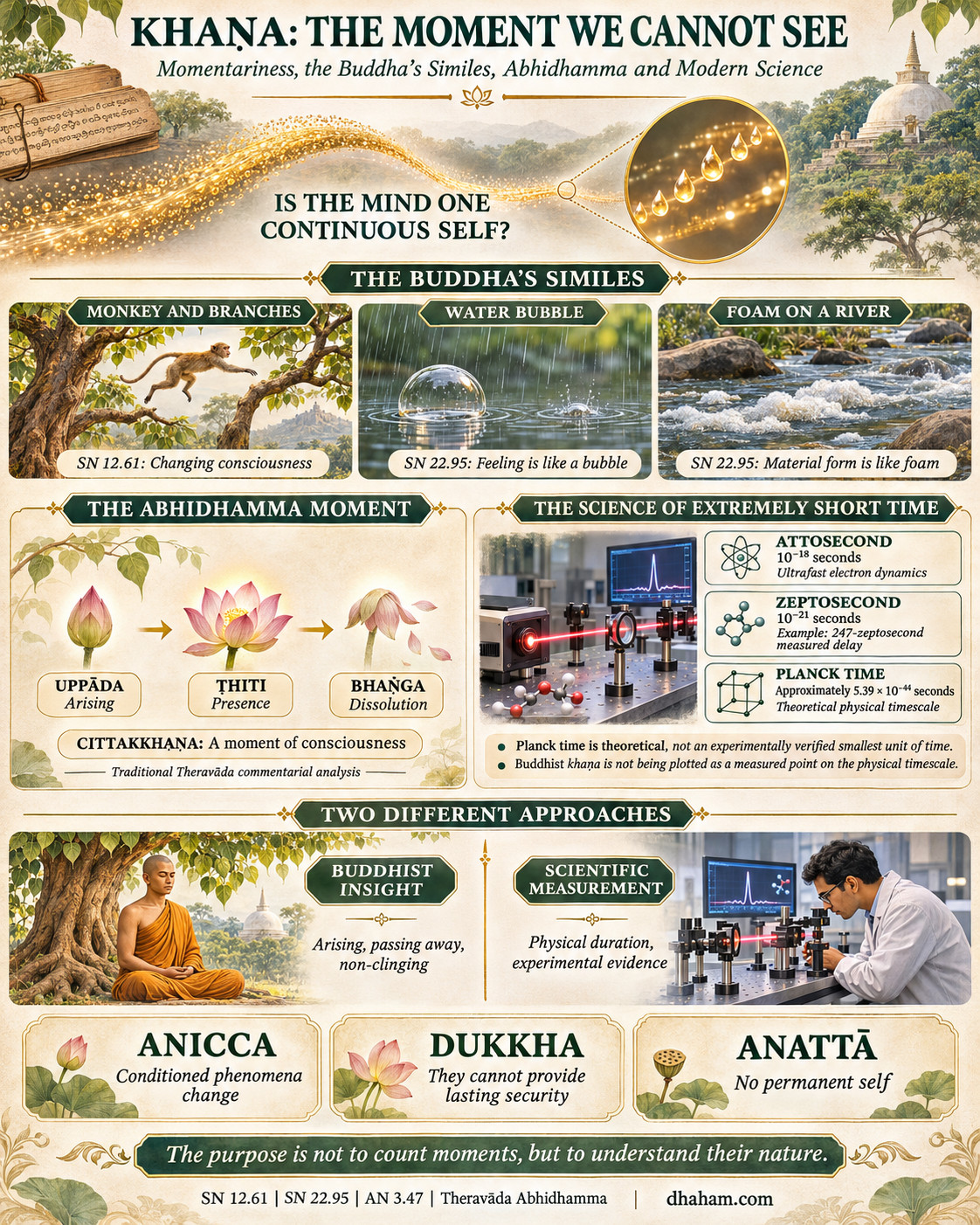
In Pāli, khaṇa means a moment or instant (Sinhala: ක්ෂණය). Later Theravāda Abhidhamma analysis uses cittakkhaṇa for a moment of consciousness. But this is not a scientifically verified smallest unit of physical time. Its importance lies in understanding impermanence, not assigning consciousness a number of seconds.
1. Why did the Buddha use similes?
The Buddha used simple, familiar examples and powerful analogies to explain profound teachings, making complex truths easier for ordinary people to understand and reflect upon. His listeners understood days, nights, seasons, and brief intervals, even though they had no modern atomic clocks or laser instruments.
Rather than explaining impermanence through physics, he offered images that could be examined in ordinary life.
A monkey grasping branches (SN 12.61). A monkey moving through a forest grasps one branch, releases it, and grasps another. The Buddha uses this to illustrate how what we call mind or consciousness arises as one thing and ceases as another. We hear, see, remember, and think, but should not mistake this changing process for an unchanging self.
Foam and a water bubble (SN 22.95). Material form is compared to a mass of river foam, while feeling is compared to a bubble on water. They may appear substantial or dependable, yet careful inspection reveals their fragility. The same discourse compares perception to a mirage, formations to a banana trunk without heartwood, and consciousness to a magical illusion.
These are aids to insight, not statements about the duration of a microscopic event.
2. What is a moment of consciousness?
In the traditional Theravāda analysis:
- Citta means consciousness, the knowing of an object.
- Cetasika refers to mental factors such as feeling, perception, intention, attention, greed, mindfulness, and wisdom that accompany consciousness.
- Cittakkhaṇa refers to a moment of consciousness arising and ceasing with its associated factors.
Citta is not a soul or permanent observer. A conditioned succession of moments can account for apparent mental continuity without requiring an unchanging owner.
The commentarial and manual tradition explains three phases:
- Uppāda: arising.
- Ṭhiti: presence or persistence.
- Bhaṅga: dissolution.
Classical manuals also describe certain material phenomena as lasting 17 mind-moments. These are internal relationships within a traditional Abhidhamma model. They are not experimentally measured intervals, and the detailed three-phase account should not be presented as a stopwatch measurement made by the Buddha himself.
The early discourses teach the arising, alteration, and ceasing of conditioned phenomena (see AN 3.47); later analysis gives momentariness a more systematic explanation.
3. How small is a khaṇa?
The honest answer is that no reliable conversion from a cittakkhaṇa to seconds has been established.
Traditional texts sometimes emphasize the astonishing rapidity of mental change through comparisons with a blink or finger-snap. These illustrate speed, but do not provide a laboratory-calibrated duration.
We therefore cannot accurately claim that one cittakkhaṇa lasts a specified number of nanoseconds, nor that the Buddha identified a physical interval smaller than every timescale in modern physics.
That distinction does not weaken the Buddhist teaching. Its aim was to reveal the conditional nature of experience, not to construct a clock.
4. What can modern science measure?
Modern physics investigates very short physical events:
Attosecond: 10⁻¹⁸ second. Attosecond light pulses enable research into electron dynamics. Work in this field was recognized by the 2023 Nobel Prize in Physics.
Zeptosecond: 10⁻²¹ second. A 2020 experiment reported a delay of about 247 zeptoseconds associated with light moving across a hydrogen molecule.
Planck time: approximately 5.39 × 10⁻⁴⁴ second. This is a theoretical timescale derived from fundamental constants, not an experimentally confirmed smallest indivisible tick of time.
Physics has not established whether time is ultimately continuous or discrete. It would be incorrect to claim that science has proved a universal minimum time, or that no future technology could ever investigate shorter physical intervals.
A cittakkhaṇa is a concept in Buddhist analysis of consciousness. Attoseconds and zeptoseconds measure physical durations. No validated method directly equates these categories. Neuroscience also has not established a one-to-one measurement of individual Abhidhamma cittas and their three phases.
Science and Buddhism are asking related but distinct questions: How rapidly can a physical process occur? How does conditioned experience arise, and how does clinging to it generate suffering?
5. What was extraordinary about the Buddha's insight?
According to the Buddhist tradition, the Buddha independently discovered and taught the path to liberation. In SN 22.58, he distinguishes a fully awakened Buddha from awakened disciples by the Buddha's discovery and teaching of a previously undisclosed path.
His achievement was not demonstrating a shorter unit of physical time than any machine can detect. It was penetrating the nature of conditioned experience and identifying a path that ends greed, hatred, and delusion.
Nor should we say that only the Buddha can realize impermanence. He taught a path through which disciples could develop insight and attain liberation.
A scientific instrument may reveal a very short event without removing craving. Likewise, knowing an Abhidhamma classification intellectually is not identical to liberating insight.
6. Khaṇa and the Three Characteristics
Anicca (impermanence): Conditioned phenomena arise, change, and cease. No conditioned experience can remain exactly as we wish.
Dukkha (unsatisfactoriness): Because conditioned things change, clinging to them cannot provide lasting security. This does not mean every moment feels painful.
Anattā (not-self): The changing aggregates, including consciousness, are not a permanent owner or independent controller of experience.
The Dhammapada expresses these insights in verses 277 to 279. Its first two statements concern all conditioned phenomena; its statement that all dhammas are not-self also includes the unconditioned Nibbāna.
The point is not to count mind-moments. It is to see their nature and weaken identification with "I" and "mine."
7. What can we practice today?
Imagine reading a hurtful message. Unpleasant feeling arises, followed by anger and repeated thoughts about the insult. It may seem as if "my anger" is one fixed thing.
Pause and investigate:
- What is known now: words, an image, a bodily sensation, or a thought?
- Is the feeling pleasant, unpleasant, or neutral?
- Is craving, aversion, or clinging strengthening the experience?
- Does the thought or sensation remain unchanged?
- What response would reflect mindfulness, truthfulness, and compassion?
You do not have to suppress feelings, imagine billions of invisible moments, or force yourself to detect a cittakkhaṇa. Begin by observing change in experience and responding wisely.
This is consistent with the practical direction of Satipaṭṭhāna and the Noble Eightfold Path. The goal is not mere fascination with tiny durations, but insight that helps end suffering.
Sources and doctrinal context
- SN 12.61: Monkey and changing consciousness.
- SN 22.95: Foam, bubbles, mirage, banana trunk, and magical illusion.
- AN 3.47: Characteristics of conditioned phenomena.
- SN 22.58: The Buddha's distinctive role in discovering and teaching the path.
- Dhammapada 277-279: Anicca, dukkha, and anattā.
- Abhidhammattha-saṅgaha: Later systematic Theravāda analysis of consciousness and materiality.
- 2023 Nobel Prize in Physics: Attosecond measurement methods.
- 2020 ultrafast molecular study: Approximately 247-zeptosecond delay.
- NIST physical constants: Planck time.
The Pāli discourses provide the foundational teachings. The detailed cittakkhaṇa model and three-phase classification belong especially to subsequent Theravāda Abhidhamma and commentarial explanations.
Final reflection
The deepest question is not whether a machine can detect the smallest instant.
It is whether we can recognize the changing nature of experience before turning it into a permanent "me."
Anicca invites us to observe change. Dukkha reveals the danger of clinging. Anattā shows that no permanent self can be found in conditioned experience.
The Buddha taught these insights to illuminate the path toward liberation, not to win a competition with scientific clocks.
Comments
No comments yet. Be the first to comment.