
Why does the mind become angry one moment and peaceful the next? Why do we experience jealousy, compassion, fear, or wisdom?
Theravāda Abhidhamma explains these changing mental qualities through 52 factors called Cetasikas.
In our earlier posts, we introduced the Four Ultimate Realities (Paramattha Dhamma):
- Citta: Consciousness
- Cetasika: Mental factors
- Rūpa: Material phenomena
- Nibbāna: The Unconditioned
After exploring the 28 Rūpa, we now examine the mental factors accompanying consciousness.
1. WHAT ARE CETASIKAS?
Citta is the knowing of an object. Cetasikas are mental factors that arise with consciousness and perform different functions.
When someone criticizes you, consciousness knows the experience. Perception recognizes its meaning, feeling may be unpleasant, and anger or mindfulness may influence your response.
According to Abhidhamma, associated cetasikas arise and cease together with citta, experience the same object, and share the same physical basis where applicable.
Every citta has accompanying cetasikas, but not all 52 arise together.
These are conditioned phenomena, not permanent personalities or independent selves.
2. THE 52 CETASIKAS
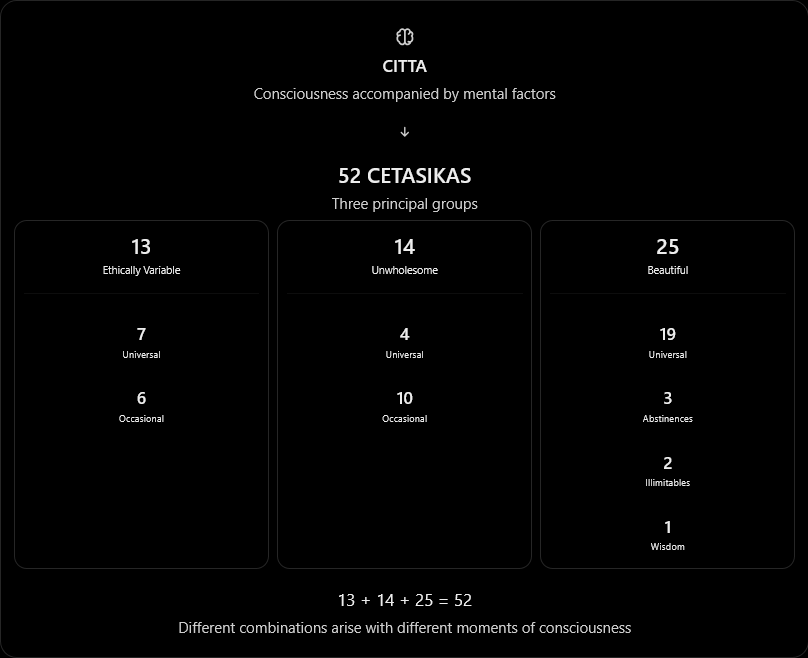
The traditional classification contains:
• 13 Ethically Variable Factors
• 14 Unwholesome Factors
• 25 Beautiful Factors
13 + 14 + 25 = 52.
A. ETHICALLY VARIABLE FACTORS (13)
These may accompany different kinds of consciousness.
Seven Universal Factors (present in every citta):
- Phassa: Contact
- Vedanā: Feeling
- Saññā: Perception
- Cetanā: Volition or intention
- Ekaggatā: One-pointedness
- Jīvitindriya: Mental life faculty
- Manasikāra: Attention
Six Occasional Factors:
- Vitakka: Initial application
- Vicāra: Sustained application
- Adhimokkha: Decision
- Viriya: Energy
- Pīti: Zest or joy
- Chanda: Desire to act
These factors are not automatically wholesome or unwholesome. Their ethical character depends on associated consciousness.
Importantly, chanda can support wholesome motivation and should not be confused with unwholesome craving (taṇhā).
B. UNWHOLESOME FACTORS (14)
These accompany unwholesome consciousness.
Four Universal Unwholesome Factors:
- Moha: Delusion
- Ahirika: Lack of moral shame
- Anottappa: Lack of moral concern
- Uddhacca: Restlessness
Ten Occasional Unwholesome Factors:
- Lobha: Greed
- Diṭṭhi: Wrong view
- Māna: Conceit
- Dosa: Hatred or aversion
- Issā: Envy
- Macchariya: Stinginess
- Kukkucca: Remorse
- Thīna: Sloth
- Middha: Torpor
- Vicikicchā: Doubt
Not all these factors arise together. Greed and hatred, for example, accompany different types of unwholesome consciousness.
Understanding these factors helps us recognize how suffering develops through mental reactions.
C. BEAUTIFUL FACTORS (25)
These accompany beautiful consciousness, including wholesome states and certain resultant and functional states.
Nineteen Beautiful Universal Factors:
- Saddhā: Faith or confidence
- Sati: Mindfulness
- Hiri: Moral shame
- Ottappa: Moral concern
- Alobha: Non-greed
- Adosa: Non-hatred
- Tatramajjhattatā: Mental balance
- Kāya-passaddhi: Tranquillity of mental factors
- Citta-passaddhi: Tranquillity of consciousness
- Kāya-lahutā: Lightness of mental factors
- Citta-lahutā: Lightness of consciousness
- Kāya-mudutā: Malleability of mental factors
- Citta-mudutā: Malleability of consciousness
- Kāya-kammaññatā: Wieldiness of mental factors
- Citta-kammaññatā: Wieldiness of consciousness
- Kāya-pāguññatā: Proficiency of mental factors
- Citta-pāguññatā: Proficiency of consciousness
- Kāyujukatā: Rectitude of mental factors
- Cittujukatā: Rectitude of consciousness
Here, "kāya" refers to associated mental factors, not the physical body.
Three Abstinences:
- Sammā-vācā: Right speech
- Sammā-kammanta: Right action
- Sammā-ājīva: Right livelihood
Two Illimitables:
- Karuṇā: Compassion
- Muditā: Appreciative joy
One Wisdom Factor:
- Paññā: Wisdom
In this classification, loving-kindness is represented by non-hatred (adosa), while mental equanimity is represented by tatramajjhattatā.
Thus:
19 + 3 + 2 + 1 = 25 Beautiful Factors.
3. HOW DO CITTA AND CETASIKA WORK TOGETHER?
Imagine receiving an insulting message.
Consciousness knows the experience. Contact, feeling, perception, attention, and intention accompany relevant moments of consciousness.
Anger may arise, followed by resentment and the intention to reply harshly.
Alternatively, mindfulness, non-hatred, and wisdom may support a thoughtful response.
The external event may be the same, but mental reactions depend on conditions such as habits, attention, and understanding.
There is no need to assume a permanent controller behind these changing processes.
4. WHY DOES THIS MATTER IN DAILY LIFE?
Understanding cetasikas helps us recognize and train our mental responses.
Anger: Notice aversion before reacting. Avoid repeatedly feeding hostile thoughts.
Jealousy: Recognize envy and cultivate appreciative joy for others.
Greed: Distinguish genuine needs from attachment that creates restlessness.
Distraction: Develop mindfulness and appropriate effort.
Compassion: Recognize suffering in others and respond with kindness.
The important insight is that these mental qualities are not permanent identities.
They arise through conditions and can change when conditions change.
5. A SIMPLE DAILY PRACTICE
When a strong emotion arises:
- Pause and recognize the mental state.
- Notice accompanying feelings and intentions.
- Investigate what is sustaining it.
- Avoid strengthening unwholesome reactions.
- Cultivate a suitable wholesome response.
For example, when anger arises, pause before replying. When jealousy appears, cultivate appreciative joy. When selfishness dominates, practice generosity.
You do not need to identify all 52 factors during meditation. Begin by recognizing wholesome and unwholesome mental states.
This develops awareness of patterns that normally operate automatically.
6. HOW DOES THIS SUPPORT ENLIGHTENMENT?
The Buddha taught four aspects of Right Effort:
- Prevent unarisen unwholesome states.
- Abandon arisen unwholesome states.
- Develop unarisen wholesome states.
- Maintain and strengthen arisen wholesome states.
Understanding cetasikas supports this training.
However, the Buddhist path goes beyond emotional regulation.
Through ethical conduct (sīla), concentration (samādhi), and wisdom (paññā), we investigate mental phenomena as:
Anicca: Impermanent
Dukkha: Unable to provide lasting satisfaction when clung to
Anattā: Not-self
The ultimate goal is the ending of greed, hatred, and delusion.
Nibbāna is not another cetasika. It is classified separately as the unconditioned ultimate reality.
7. ULTIMATE TRUTH AND CONVENTIONAL IDENTITY
We commonly say:
"I am angry."
"I am jealous."
"I have a peaceful mind."
These expressions are useful in everyday communication.
However, Abhidhamma encourages us to investigate the underlying mental processes.
Anger is a conditioned mental factor.
Envy is a conditioned mental factor.
Mindfulness and wisdom are also conditioned mental factors.
None is a permanent self.
Recognizing this does not eliminate responsibility. Instead, it shows why our intentions, actions, and mental training matter.
We can weaken harmful tendencies and develop beneficial qualities.
8. SCRIPTURAL REFERENCES
The Abhidhamma Piṭaka is part of the Theravāda Pāli Canon and analyzes mental and material phenomena.
The systematic list of 52 cetasikas is especially prominent in the later Abhidhammattha-saṅgaha, Chapter II.
Related discourses include:
• MN 10: Satipaṭṭhāna Sutta, mindfulness of mental states.
• MN 19: Dvedhāvitakka Sutta, cultivating wholesome thoughts.
• SN 45.8: Maggavibhaṅga Sutta, the Noble Eightfold Path.
• SN 22.59: Anattalakkhaṇa Sutta, the not-self nature of the aggregates.
The 52-factor classification is a traditional Buddhist analytical framework, not a modern neuroscientific model.
FINAL REFLECTION
Your mind is not a fixed personality that can never change.
What we call "my mind" consists of conditioned moments of consciousness accompanied by mental factors.
Greed, hatred, and delusion can be weakened.
Mindfulness, generosity, goodwill, and wisdom can be cultivated.
The purpose of understanding the 52 cetasikas is not simply memorizing Pāli terminology.
It is to understand how suffering develops, recognize the conditions behind mental reactions, cultivate wholesome qualities, and develop insight leading toward liberation.
The greatest opportunity is not merely to know what happens in the mind.
It is to understand the mind deeply enough that ignorance and craving no longer control it.
Comments
No comments yet. Be the first to comment.